The Mind, Mathematics and Sustainable Development
This post is about the talk I gave on the International Day of Mathematics, March 14, 2023.
Abstract:
In this talk we will first reflect on how mathematics emerges from the ability of the mind to "zoom in" on the logical structure of the universe. Guided by this point of view, we will engage in a discussion about challenges in teaching and learning mathematics and the prospects for the bigger role that mathematics could play towards sustainable development.
About the speaker:
Zurab Janelidze is a professor of mathematics at Stellenbosch University. He is an associate of NITheCS and a principal investigator in one of the research programmes at NITheCS. He serves on the editorial boards of two international journals in his field of expertise, category theory, and serves as the president of the South African Mathematical Society. He is passionate about discovering and teaching mathematics, as well as looking for mathematical structures in other art forms.
Slides:
The talk:2022 Academic Activities
Summary
- Initiated seven new collaborative research projects within the Mathematical Structures research programme, that includes researchers and postgraduate students from various universities in South Africa: operator semigroups, measure structures, metric frames, canonical extensions, ranked monoids, sum structures, lower topology.
- Supervised and co-supervised nine postgraduate students (two honors, two masters, and five phd).
- Represented South Africa at the General Assembly of the International Mathematical Union along with a colleague in Mathematics Education.
- In collaboration with colleagues and students, developed and delivered a successful math-music theatrical production for the celebration of the International Year of Basic Sciences for Sustainable Development. The production was supported by NITheCS, ASSAf and DSI.
- Developed and delivered four national postgraduate courses online: SOFiA on python, mathematical structures (in collaboration), introductory set theory (in collaboration), category theory.
- Executed presidential duties for SAMS: chairing of SAMS council meetings, of the AGM, opening and closure of the SAMS congress, etc. Prepared and delivered presidential address at the AGM (in consultation with the SAMS Council) to give a direction to SAMS activities in the coming years.
- Elected as NITheCS associate co-representative, and in this role, served on the NITheCS management committee monthly meetings.
- Ran the national research programme in mathematical structures under NITheCS along with three other principal investigators in the research programme.
- Two co-authored papers published, one in Journal of Symbolic Logic. Co-authored paper in Order accepted for publication.
- Served on the programme committee of the international conference "Topology, algebra and categories in logic" held in Coimbra, Portugal.
- Gave two interviews (radio and youtube).
- Taught and co-taught and/or convened six modules at Stellenbosch University, including two engineering mathematics modules, one honors module and two third-year modules.
- Progress made on existing and new research projects and delivered talks on those.
- Carried out duties in the role as mathematical sciences programme coordinator and member of a university research committee.
- Carried out refereeing and editorial duties (not listed below).
November-December 2022
- Research discussion (9 December) with Dr. Christian Budde: started research project on the category theory of operator semigroups.
- Chaired the Annual General Meeting of the South African Mathematical Society (8 December).
- Gave a SAMS Congress talk on the noetherian form of sets.
- Gave opening and closing speeches at the 65th Congress of the South African Mathematical Society (6-8 December), held at Stellenbosch University.
- Gave an opening speech at the special meeting of the Mathematics section of National Graduate Academy (5 December).
- Chaired the fourth Council Meeting of the South African Mathematical Society (2 December).
- Conducted weekly 6-hour tutorial sessions in November for students in Foundations of Abstract Mathematics I for additional assessment opportunity.
- The paper on ordinal number systems fully published in the Journal of Symbolic Logic.
- Submitted author comments on the journal proofs of the paper on stack combinatorics (joint work with Helmut Prodinger and Francois van Niekerk). The paper is being published by Springer Order.
- Hosted research visit (18-20 November) of Dr. Cerene Rathilal. Started joint work on measure structures.
- Submitted a report on the Mathematical Structures Research Programme at NITheCS and delivered a talk at the NITheCS Associates Workshop on the progress of the research programme.
- Made progress with Kishan Dayaram on diagram lemmas in the context of noetherian forms.
- Fundamano production (4 November) was a success -- full house attendance and well received. See: videos, press release.
September-October 2022
- Gave a talk on at the "Topology, Algebra, and Category Theory" international conference (19-22 September) dedicated to the 65th birthday of Themba Dube. The subject of the talk was metric frames.
- Supervised original honors projects of Gregor Feierabend and Gideo Joubert.
- Gave a semester honors course on Logic.
- Taught the English group of Engineering Mathematics 242 in the second semester of 2022.
- Chaired the third Council Meeting of the South African Mathematical Society (7 October).
- Hosted research visit (20 September - 8 October) of my PhD student, Noluntu Baart, to work on deductive reasoning in intermediate-phase mathematics education.
- Hosted research visit (9 October - 9 December) of my PhD student, Kishan Dayaram, to make progress on three joint papers.
- Hosted research visit (9-26 October) of Dr. Partha Pratim Ghosh. Joint work on canonical extensions started.
- Rehearsed and prepared for the Fundamano production in a team of students. This is a theatrical production bringing mathematics on stage, celebrating the international year for basic sciences.
- Drafted a paper based on the research on the category of near-vector spaces (co-authored with my MSc student, Daniella Moore, and the co-supervisor, Dr. Sophie Marques).
- Gave a National Graduate Academy course on category theory. Click here for videos and lecture notes.
- Gave a South African Theory School course on mathematical structures (jointly with Dr. Cerene Rathilal and Dr. Partha Pratim Ghosh). Click here for videos and lecture notes.
- Spoke on "Is Maths Trauma a real thing?" at the radio show Weekend Breakfast with Refiloe Mpakanyane. Click here for the podcast.
July-August 2022
- Organised a Research Workshop (5 July) on the occasion of visit (5 July) of Dr. Francois Schulz. Collaboration started on ranked monoids.
- Organised a Research Workshop (14 July) on the occasion of the research visit of Prof. Dharmanand Baboolal and Dr. Cerene Rathilal. Collaboration started on metric frames.
- Represented South Africa at the General Assembly of the International Mathematical Union (July 3-4, the report of the meeting is available here).
- Gave the August NITheCS mini-school on Elementary Introduction to Set Theory together with Dr. Amartya Goswami.
- Gave a Foundations of Abstract Mathematics I seminar on arithmetic and proof composition.
- Started research on the category of near-vector spaces (joint work with Dr. Sophie Marques and Daniella Moore).
- Leading programme renewal discussions in Mathematics in the second semester of 2022.
May-June 2022
- The paper on matrix taxonomy was published in Theory and Applications of Categories.
- Hosted research visit (1-4 June) of Dr. Charles Msipha to advance progress on sum structures.
- Continued research on a noetherian form of sets -- see the updated paper.
- Chaired the second Council Meeting of the South African Mathematical Society (26 May).
- Prepared an International Year for Basic Sciences for Sustainable Development project, which would later be called Fundamano. The project is listed on the official website of this international initiative. Dr. Charles Msipha and Dr. Sophie Marques are co-founders of the project.
- Elected as a NITheCS Associate Representative. Duties include serving on the NITheCS Management Committee (meetings are held monthly).
- Served on the programme committee of the international conference "Topology, algebra and categories in logic" held in Coimbra, Portugal.
March-April 2022
- Revisited research on a noetherian form of sets (joint work with Dr. Francois van Niekerk).
- Organised a Research Workshop on Monoidal Sum Structures at Stellenbosch University (20-25 March) and hosted the visit of Dr. Charles Msipha (Tshwane University of Technology). See the Mathematical Structures Research Programme website for further information. Two research projects dealing with sum structures were initiated at this workshop.
- Organised a Research Workshop on Lower Topology at Stellenbosch University (3-10 April) and hosted the visit of Dr. Amartya Goswami and Ms. Micheala Hoenselaar (University of Johannesburg). A research project on lower topology was initiated at this workshop.
- Gave an interview at the Meet a Mathematician series (see https://youtu.be/lOLIc8Jnja4).
- Supervised a 3rd year research project by Jean du Plessis (under Foundations of Abstract Mathematics II).
January-February 2022
- Serving on the Subcommittee B of the Research Committee of Stellenbosch University for 2022.
- Serving on the Programme Committee of the Faculty of Science of Stellenbosch University for 2022.
- Setting up Mathematical Structures Research Programme at the National Institute for Theoretical and Computational Sciences, along with Prof. Yorick Hardy, Dr. Partha Pratim Ghosh, and Dr. Cerene Rathilal.
- Delivered online lecture series Python-Based Introduction to Mathematical Proofs for the The 12th CHPC Introductory Programming School and The 4th NITheCS Summer School on the Foundations of Theoretical and Computational Science.
- Teaching Engineering Mathematics 214 (together with Dr. Liam Baker, Dr. Ronalda Benjamin, and Dr. Michael Hoefnagel) in the first semester and giving a Foundations of Abstract Mathematics I seminar in Mathematical Reasoning in the first term. Also teaching a third-year module, Topology, in the first semester.
- Convening Foundations of Abstract Mathematics I & II (year modules) and Topology (semester module) in 2022.
- Started/resumed (co-)supervision of the following postgraduate students: Noluntu Baart (PhD), Roy Ferguson (MSc), Kishan Dayaram (PhD), Paul Hugo (PhD), Brandon Laing (PhD), Daniella Moore (MSc), Ineke van der Berg (PhD).
- The paper on ordinal number systems appeared online in the Journal of Symbolic Logic (joint work with Ineke van der Berg).
- Assumed the role of the President of the South African Mathematical Society for the term 2022-2023. Chaired the first Council meeting (11 Feb).
- Under the research assistantship of Gregor Feierabend, the first prototype of a Haskell implementation of the SOFiA proof assistant was produced. See source code on GitHub or the live software.
Elementary Introduction to Set Theory
This is the blog post of the 2022 August NITheCS Mini-School. Let us begin with some useful links:
- Lecture notes on universes of sets (introductory)
- Some videos explaining the concepts from the lecture notes above
Lecture 1

Lecture 2

Lecture 3
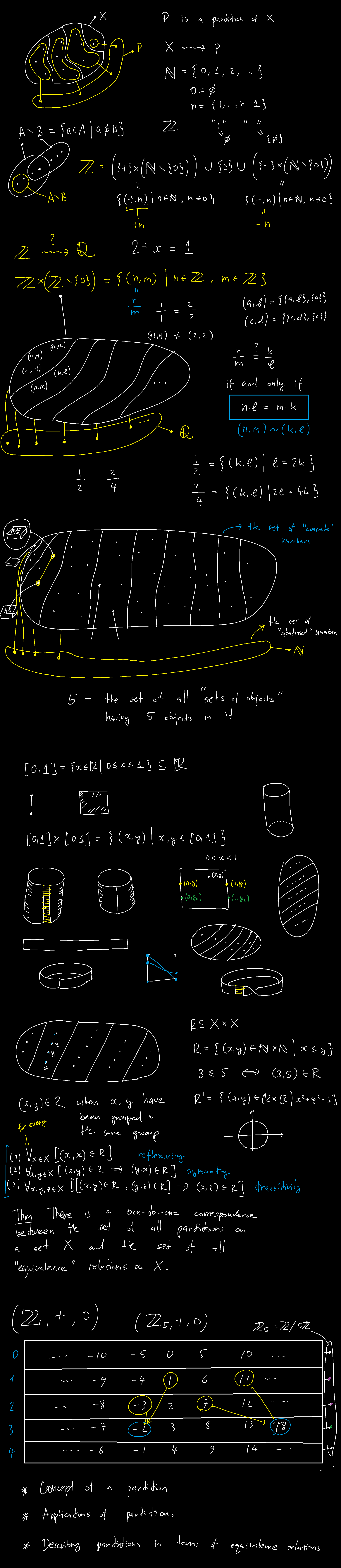
Lecture 4

The Transition from High School Mathematics to University Mathematics
These are notes in progress for a talk given at the online user group conference of the advanced programme mathematics organized by ieb (19 February 2022)
1. Introduction
2. Misleading Questions
3. Factual Teaching vs Insightful Teaching
- "sketch" instead of "graph" (or "sketch of the graph").
- Wilson says "-3 is not included" (it is rather the paint (-3,-1) that is not included in the graph) but "4 is included" (similarly, 4 is merely the x-coordinate of the point included in the graph).
- Wilson says that the domain is "where your graph is on the x-axis", and "range is where the graph is on the y-axis".
- Wilson says "if it is not defined, we put a round bracket, if it is defined, we put a square bracket".

4. Contribution from Dr. Cerene Rathilal

5. Challenge, Passion and Hard Work
6. Final Note ♪
7. Some Feedback from Students
Noetherian information systems
These are notes for a colloquium talk to be given at NITheCS.
The Snake Lemma from this fragment of a 1980 film ("It's My Turn", starring Jill Clayburgh and Michael Douglas), along with many other similar theorems in abstract algebra, known to be true for a variety different algebraic settings, can all be established in a unified setting of noetherian forms. This post attempts to give a preliminary step towards a possibly ambitious goal of applying noetherian forms outside abstract mathematics. In this light we propose a variation of this notion, a "noetherian information system", which is intended to be more agile in terms of identifying applications.
General Information Systems
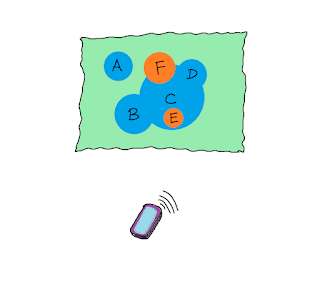
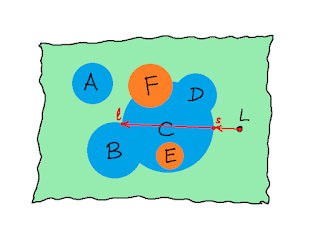
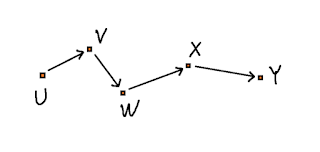
- If we think of E as the range of possible locations of the cellphone, then E gives more information about the location of the cellphone than C does. We call this the classical interpretation. In this interpretation, E being part of C gets interpreted as E "implying" C in the sense of classical mathematical logic.
- If we think of each possible location as an attribute of the cellphone, then we can interpret E to be a state of the cellphone in which the cellphone has less attributes than in the state C. We call this the quantum interpretation, since with this interpretation, the information cluster E is seen as a state where the cellphone is simultaneously in all locations within the region E.
Inputs and Outputs
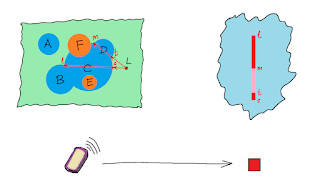
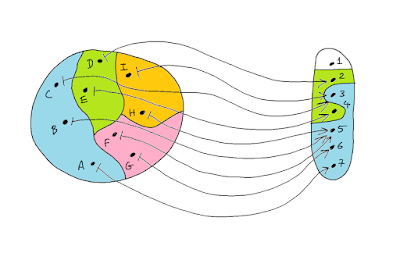
- Any transmission with the same target as that of the input, whose every reach is a reach of the input, arises as a composite of the input transmission with a transmission to the source of the input.
- The input transmission maps clusters injectively (i.e., different clusters do not transmit to the same cluster).
- Any cluster that is part of a reach of the input transmission is itself a reach of the input transmission.
- Any transmission with the same source as the output, whose every non-stash is a non-stash of the output, arises as a composite of the output with a transmission from the target of the output.
- If the output transmission maps a cluster B to part of a clusters A, and all stashes are part of A, then B is part of A as well.
- Any cluster in the target of the output is a reach of the output transmission.
- Any transmission decomposes as an output transmission followed by an isotransmission and followed by an input transmission.
- For any two inputs there is a third input whose reaches are precisely those clusters which are reaches of both initial inputs.
- For any two outputs there is a third output whose stashes are precisely those clusters which are parts of every single cluster containing all stashes of both initial outputs.
Mathematical Examples
Topological Information Systems
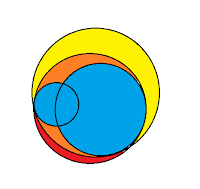
- The first information system is not topological since clusters there are always circular regions of a plane. It is impossible to superpose two circular regions into another circular region. Note that a superposition of a set S of clusters is formally defined as a cluster J such that every member of S is part of J and moreover, J is part of any other cluster K that has the same property (i.e., that every member of S is part of K). So superposition of two disks should be a disk which contains both, but which is contained in any other disk containing both. Such disk does not exist unless one of the two disks contains the other: on the illustration below, an attempt to superpose two blue disks must produce a disk that wholly lies both in the yellow disk and the red disk, i.e., that lies in the orange region, while at the same time contains both blue disks -- this is not possible.
- Although non-zero finitely many closed intervals can be superposed, infinitely many, in general, cannot be superposed.
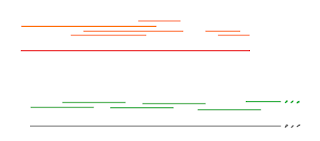
- In both cases, empty superposition is not possible.
- the smallest cluster is transmitted to the smallest cluster, and
- superposing clusters in the source information system and then transmitting the resulting cluster, is the same as first transmitting the initial clusters and then superposing them in the target information system.
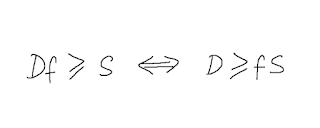
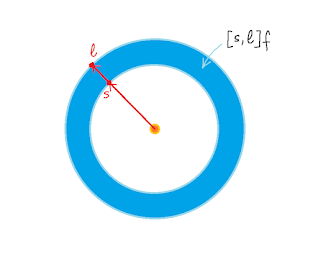
- Reverse transmission is monotone and it preserves meets of clusters (a meet of a set of clusters is defined as the largest cluster that is part of each cluster).
- Transmission followed by reverse transmission results in expansion of the cluster.
- Reverse transmission followed by transmission results in shrinking of the cluster.
- Transmission, then reverse transmission, and then transmission again, results in the same cluster as by initial transmission. There is a similar property starting with reverse transmission in the place of transmission.
Concluding Remarks
- Is there a useful real-life interpretation of a noetherian information system?
- If yes, does it lead to the ability to usefully model real-life information systems as noetherian information systems?
- In particular, are there any applications in machine learning or data science?
- Or, is it perhaps possible to use noetherian information systems to usefully model function of a living organism, or maybe, cognitive function of a human being?
- Does the category of Hilbert spaces, which is neither an abelian nor a semi-abelian category, but which plays an important role in quantum mechanics, have a noetherian form?
- Can the physical universe be modelled as a noetherian information system?
The poset of matrix properties
Below are the notes for the talk above, given at the Algebra, Geometry, Topology & Applications seminar.
1. Bird's-Eye View of Exactness Properties
One of the active areas of research in Categorical Algebra is the study of various properties of categories expressed using limits and colimits. Such properties are usually referred to as exactness properties. This terminology comes from the fact that, historically, the first such properties emerged in the study of exact sequences in the sense of Homological Algebra. The matrix properties in the title of this post are particular types of exactness properties, which can be encoded using integer matrices. Before explaining what they are, let us first recall the notions of limit and colimit.
Given a diagram of objects and arrows (objects are certain mathematical structures and arrows are morphisms between them), a limit (of the diagram) is a way to encode the information about the diagram in a single object; it is a terminal (commutative) cone over the diagram. The notion of a colimit is defined by "reversing arrows" in the definition of a limit.

- Various complex topological spaces are colimits of diagrams of simpler spaces.
- Higher dimensional vector spaces are limits of lower dimensional spaces.
- Cartesian products of mathematical structures (e.g., sets, groups, topological spaces with the Tykhonov topology) are instances of limits.
- Every set is a colimit of singleton sets. A singleton set itself is a limit of the empty diagram.
- Starting with a unit interval, combining limits and colimits we can build spaces such as the sphere, the torus and the Klein bottle (among many others).
- The monoid of words decomposes as a colimit of multiple copies of the additive monoid of natural numbers.
- Taking the quotient of a mathematical structure (e.g., of a set by an equivalence relation, or of a group by a normal subgroup), is an example of a colimit.
- Intersection of subsets of a set and inverse image of a subset along a function are examples of limits.
- Profinite structures (e.g., profinite groups) are special types of limits of finite structures.
- Addition and multiplication of natural numbers are examples of colimits and limits.
- etc.
- For a given diagram, its limit (as well as colimit), when the latter exists, is unique, but only up to isomorphism.
- Every limit is a colimit in the dual category (a category obtained from a given one by reversing the direction of arrows).
2. Matrix Properties

- The category of groups. If X is a group, then we can express A as e.g. A = C - F + D.
- The category of lattices. If X is a lattice, then we can express A as e.g. A = (C /\ D) \/ (D /\ B) \/ (B /\ C).
3. The Algorithm
- Expansion: when a new dimension is added to the cube (in any position), but the colored vertices do not change their position.

- Collapse: when one of the dimensions of the cube is collapsed and the colored vertices are projected along the collapsing dimension.

- Tilt: when given two dimensions in the cube, such that all colored vertices are on the same end of the first dimension, colored vertices on one side of the second dimension slide along the edges of the first dimension.

- Inside-out turn: when all colored vertices change their position on the edge of a given dimension.

4. Computer-Generated Results


- Mal'tsev + majority ("arithmetical"),
- Mal'tsev + 4-near-unanimity,
- majority,
- 4-minority,
- refinement of Mal'tsev with directly decomposable congruences,
- minority,
- Mal'tsev,
- 3-edge,
- 4-ary near unanimity,
- 4-edge,
- refinement of directly decomposable congruence classes,
- refinement of the egg-box property,
- refinement of normal local projections.
5. Some Theorems and Concluding Remarks

- In this post, we limited our attention to binary matrix properties, i.e., when the entries in the matrix are either 0 or 1. The theorems above are valid only in the binary case. The geometric interpretation of matrix properties using n-dimensional cubes is also only valid in the binary case.
- The algorithm for deciding implications of matrix properties was established in [HJJ]. The pictures of some fragments of the poset of matrix properties are also from [HJJ].
- The theorems above are from [HJJvdW].
- Matrix properties were first introduced in [J] (see [HJJ] for additional references).
- Majority categories were first introduced in [H], by an application of the "matrix method" for translating universal-algebraic properties into exactness properties described in [J].
- The notion of a Mal'tsev category, defined in the context of categories having finite limits, first appeared in [CPP].
- This post is an extension of another post, which gives a shorter and a complementary account of the results discussed here.
- The geometric interpretation of the algorithm presented in this post is an original contribution of the post. A paper will be written up on it, hopefully some time soon.
- Moving diagrams were designed on Geogebra, recorded using Wondershare UniConverter, and turned into gif files using ezgif.
- Python implementation of the algorithm can be found here. The software is called "mclex".
- The fourth author of [HJJvdW] was a first-year student at Stellenbosch University, when he joined the research project.